



Jeep Cherokee vs Compass: Which Crossover is Right For You?

The Jeep Cherokee and Jeep Compass are two very similar vehicles.
Not only are they barely distinguishable from one another from the outside, but they are also similarly sized, similarly priced, and available with a similar range of engines and optional extras.
SEE ALSO: Honda CR-V vs Honda HR-V: Which Crossover is Right for You?
If you’re in the market for a small Jeep crossover, choosing between these two can be a challenge. In this post, we’ll compare these two in all relevant categories, hopefully leaving you with an idea of which of these Jeeps is better suited to your needs and lifestyle.
Jeep Cherokee vs Compass
Design

Jeep Compass: the Compass is a modern-looking crossover with short overhangs that give it a taut and upright appearance. It also has LED daytime running lights, available LED headlamps, an available black contrasting roof, 19-inch wheels and other cosmetic add-ons that lend to its overall appearance. Thanks to its tidy and youthful design, the Compass should age well too.

Jeep Cherokee: The Cherokee and Compass look extremely similar. The Cherokee is similarly modern and youthful, although it is now a bit less radical thanks to the redesigned fascia and rear end. The Cherokee is also offered with LED daytime running lights and LED headlights, along with available 19-inch wheels.
The Cherokee isn’t as recent as the Compass and it shows, appearing a bit older than its smaller sibling, to our eye.
Bottom Line: The Compass looks a bit better than Cherokee, in our opinion, with a more modern and upmarket design that will age better. Both of these crossovers are neatly styled, however, and look fairly alike.
ALSO SEE: 2019 Jeep Cherokee Pros and Cons
Space/Practicality

Compass: The Compass is a mid-size crossover with seating for five. It has front row headroom of 39.2 inches, front row legroom of 41.8 inches, and front row shoulder room of 56.7 inches. Second-row headroom is 38.5 inches, while second-row legroom measures in at 38.3 inches and shoulder room at 55.1 inches.
Jeep claims a cargo volume of 27.2 cu-ft with the rear seats up and 59.8 cu-ft with them folded down. It has a total interior volume of 126.7 cu-ft.
 Cherokee: The Cherokee is also a mid-size crossover with seating for five. Jeep claims front row headroom of 39.4 inches, along with front row legroom of 41.1 inches and front row shoulder room of 57.6 inches. Second-row headroom is a similar 38.5 inches, while second-row legroom sits at 40.3 inches and second-row shoulder room at 55.1 inches.
Jeep also claims a cargo volume of 25.8 cu-ft. with the rear seats up and 54.7 cu-ft. with them folded down. It has an interior volume of 128 cu-ft.
Bottom Line: These vehicles are similarly sized, with the Compass offering slightly more legroom for front passengers due to its superior packaging, but the Cherokee has more total interior volume.
ALSO SEE: Jeep Compass Review
Powertrains/Fuel Economy

Compass: The Compass is offered with a 2.4-liter four-cylinder engine, which is rated at 180 hp and 171 lb-ft of torque, and a nine-speed automatic transmission. Front-wheel drive is standard, but all-wheel drive (marketed as 4×4) is available as an option. A six-speed manual transmission is also offered.
According to the EPA, the FWD Compass automatic returns 22 MPG city and 31 MPG highway for a combined rating of 25 MPG. AWD models are rated at 22 MPG city and 30 MPG highway for 25 MPG combined.
Manual FWD models are rated at 23 MPG city and 32 MPG high for 26 MPG combined, while manual AWD models get 22 MPG city and 31 MPG highway for 25 MPG combined.
ALSO SEE: What’s the Difference Between 4WD and AWD?
Cherokee: The Cherokee is offered with three engines: a 2.4-liter four-cylinder, a 2.0-liter turbocharged four-cylinder, and 3.2-liter V6. All engines are available with either FWD or AWD and a nine-speed automatic is the only transmission option.
The 2.4-liter engine is the same one in the Compass and is rated at 180 hp and 171 lb-ft of torque. The 2.0-liter turbo, meanwhile, is good for 270 hp and 290 lb-ft of torque, while the V6 makes 270 hp and 239 lb-ft of torque.
The 2.4-liter FWD models are rated at 22 city and 31 highway for a combined rating of 25 MPG. Adding AWD drops the ratings to 21 MPG, 29 MPG and 24 MPG, respectively. 2.0-liter FWD models are rated at 23 MPG city and 31 MPG highway for 26 MPG combined, while AWD 2.0-liters get 21 MPG city, 29 MPG highway and 24 MPG combined. FWD V6 models return 20 MPG city 29 MPG highway 23 MPG combined, and AWD V6 models get 19 MPG city 27 MPG highway and 22 MPG combined.
Bottom Line: The Cherokee has many more powertrain options and gets similar fuel economy despite having more weight to lug around. It definitely has the upper hand with regards to powertrains, however, if you want a manual transmission, then you’ll be forced into the Compass.
ALSO SEE: Jeep Renegade vs Compass: Which Jeep is Right for You?
Driving Dynamics

Compass: When we drove the 2019 Jeep Compass, we said it “rides adequately, and that “the steering gives off a feeling of heft and command based on how heavy it is.” We didn’t like the 2.4-liter engine, though, saying the ” Compass never feels as fast or powerful as the numbers would suggest.”
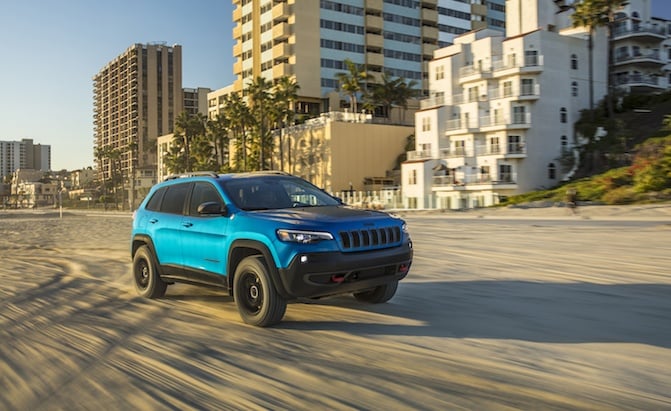
Cherokee: When we drove a Jeep Cherokee Trailhawk (that’s the off-road-focused model) we said that “hitting the gas or brakes causes the vehicle to sway up and down in a very noticeable way,” due to the optional soft suspension, although regular models won’t have this issue. We also said the steering was “acceptable,” although a bit numb and we weren’t big on the nine-speed transmissions penchant to jump around between gears.
Bottom Line: While neither of these vehicles offers outstanding on-road driving dynamics, they both offer good available capability thanks to Jeep’s all-wheel drive system. The Cherokee’s three engines allow you to select a powertrain that better suits your driving style, but if you don’t appreciate off-road capability, you may want to look elsewhere for a truly stellar on-road driving experience.
Technology

Compass: The Compass is available with the latest version of Jeep’s Uconnect infotainment system with Apple CarPlay, which is available with a range of screen sizes including the 7-inch display. A 7-inch TFT driver’s display is also available, along with active safety features such as blind spot monitoring, forward collision warning with active braking and much more.
 Cherokee: The Cherokee is offered with very similar tech including an available 8.4-inch Uconnect infotainment system with Apple CarPlay (lesser models offer the 7-inch also in the Compass) along with active safety tech like blind spot monitoring, forward collision alert with full speed active brake and available adaptive cruise. The Cherokee also has tow-friendly tech like trailer sway control that the Compass does not.
Bottom Line: The Cherokee offers trailer sway control for those who want to tow, but that’s really the only discernible advantage over the Compass tech-wise. The interior tech, having been taken from the same Fiat Chrysler/Jeep parts bin, is nearly identical, although the Cherokee offers an optional 8.4-inch screen over the Compass’ max screen size of 7-inches.
Pricing
Compass: The FWD, manual Jeep Compass starts at $23,808, but the cheapest model offered with more basic features, the Compass North, starts at $27,041.
Cherokee: The FWD Cherokee 2.4-liter starts at $27,021, while the next step up, the Cherokee North, is priced from $30,171.
Bottom Line: These vehicles are very similarly priced. For the base price of the Cherokee, you can get a more well-equipped Compass. If you prefer size over features and amenities, the Cherokee is probably the better buy for you. You’ll get more features into a Compass for the same price, however, which some consumers may prefer.
ALSO SEE: Nissan Rogue vs Murano: Which SUV is Right for You?
The Verdict: Jeep Cherokee vs Compass

These vehicles are very similar, but they each have their own advantages.
The Compass has more mature styling, in our opinion, and looks more upmarket. It is also less expensive and has good interior and cargo space for being a compact.
The Cherokee, meanwhile, offers three powertrains versus the Compass’ one, including a powerful 2.0-liter engine. It also has a towing package. This sets the Cherokee apart from the Compass and positions as more of a true SUV than a crossover.
If you’re just looking for a daily driver, the Compass may be better suited to you. If you want to tow or frequently carry a lot of cargo, the Cherokee might be the better pick.